

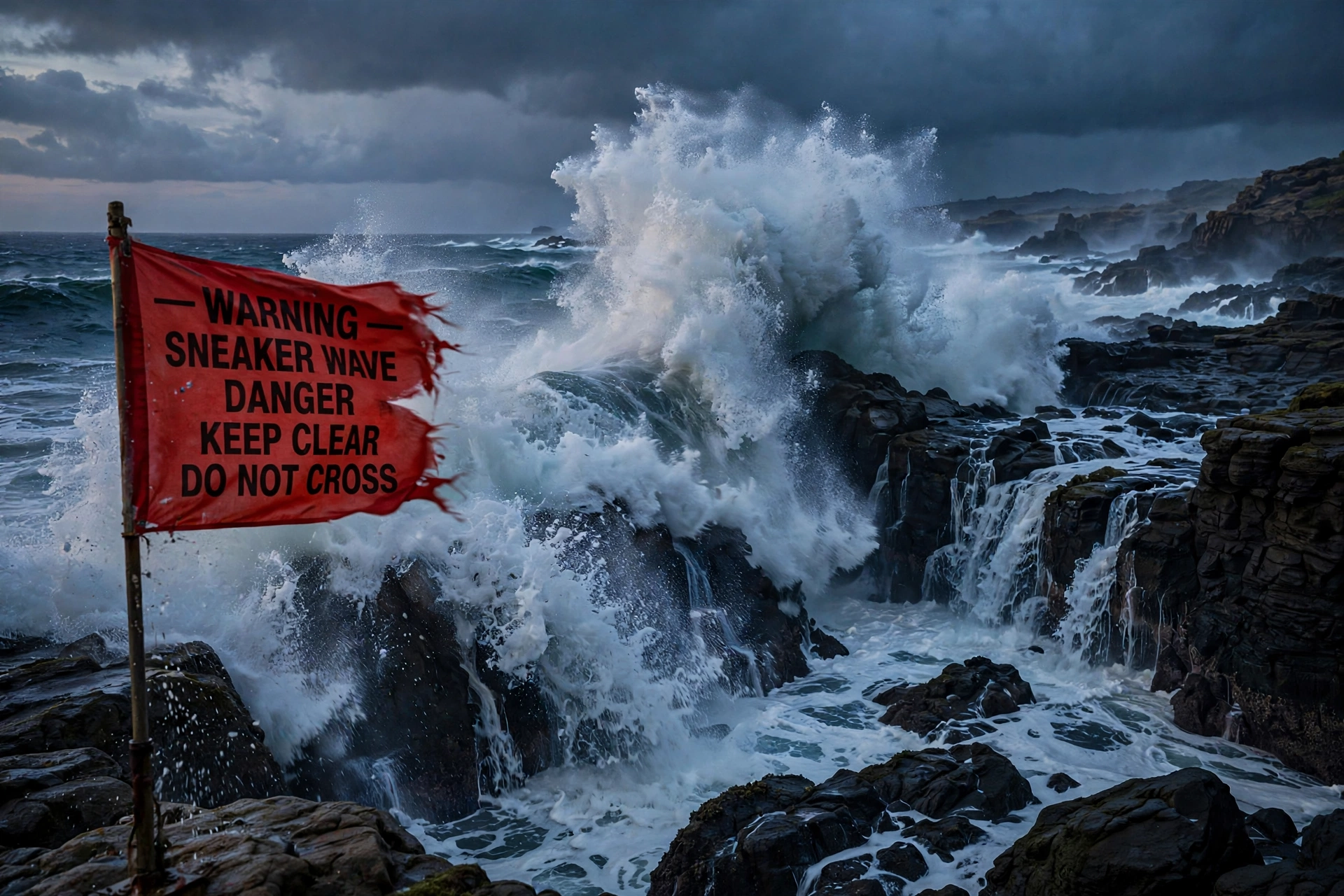
If you have ever scrolled through a weather forecast before a coastal vacation and spotted the phrase beach hazards statement, you may have wondered what it actually means — and whether it should change your plans. A beach hazards statement is an official alert issued by the U.S. National Weather Service (NWS) when dangerous beach or ocean conditions threaten the safety of swimmers, surfers, and beachgoers. It is not issued casually: it signals that hazards such as strong rip currents, sneaker waves, large breaking waves, high surf, or minor coastal flooding are expected or already occurring along a stretch of coastline.
Right now, this alert is making headlines: the NWS office in Eureka, California has issued a beach hazards statement for the North Coast, in effect through Wednesday afternoon, warning of sneaker waves, powerful rip currents, and large breaking waves. Search interest has surged past 20,000 queries in the United States and keeps climbing.
This guide covers what a beach hazards statement means, why the NWS issues one, how to read the alert, what sneaker waves and rip currents are, exactly what to do if caught in a rip current, and a practical beach safety checklist.
Key Facts: Beach Hazards Statement
- Issued by: The U.S. National Weather Service (NWS)
- Meaning: Dangerous beach or ocean conditions are expected — rip currents, sneaker waves, high surf, large breaking waves, or coastal flooding
- Current example: NWS Eureka / North Coast California — in effect through Wednesday afternoon, September 2026
- Top dangers: Sneaker waves, strong rip currents, large breaking waves
- Core guidance: Stay off jetties, piers, and rocks; remain out of the water; NEVER turn your back on the ocean
- If caught in a rip current: Do not fight it — swim parallel to the shore to escape, then back to the beach; if you cannot escape, float or tread water and wave for help
What Is a Beach Hazards Statement?
A beach hazards statement is a specialized weather alert issued by the U.S. National Weather Service to warn the public of hazardous conditions along beaches and shorelines. It belongs to the family of marine and coastal weather products — alongside high surf advisories, coastal flood warnings, and small craft advisories — that the NWS produces to protect lives and property. Where a severe thunderstorm warning tells you to seek shelter from a storm, a beach hazards statement tells you the ocean itself has become dangerous.
The statement is triggered when forecasters expect strong rip currents, sneaker waves, large breaking waves, high surf, or minor coastal flooding. It names the affected coastline, gives the time window, describes expected impacts, and lists precautionary actions — a complete briefing on a coastline that has temporarily turned hostile.
A related product is the Rip Current Statement, which specifically warns of a high rip-current threat — covering what is happening, where, when, the expected impacts, and precautionary actions. Learn more at the Rip Current Statement reference page. In practice, many beach hazards statements are issued precisely because rip current risk has spiked.
Why the National Weather Service Issues a Beach Hazards Statement
The National Weather Service issues a beach hazards statement for one reason: to save lives. Coastal forecasters monitor ocean buoy readings, wave models, tide predictions, wind patterns, and nearshore current forecasts to detect when conditions are aligning to create shoreline danger. When models and observations agree that hazards like strong rip currents, sneaker waves, large breaking waves, or high surf are imminent, the NWS issues the statement so officials, lifeguards, news outlets, and the public can act.
Rip currents are one of the most common triggers. The NWS and NOAA run daily surf zone forecasts with rip current outlooks, and a high-risk outlook can trigger an alert. The U.S. Coast Guard advises staying clear of beaches until lifeguards or law enforcement say conditions are safe, and treating rip currents as life-threatening rather than a minor inconvenience.
Sneaker waves are another frequent driver, especially along the Pacific coast, where long-period swells from distant storms can travel thousands of miles before striking the shoreline. An NWS forecaster explained that a sneaker wave is a large, unexpected wave arriving without warning — “you can have 20 to 30 minutes of really small waves… then a few wave sets much larger” — and wet sand on the beach signals a recent surge. These waves have swept beachgoers, photographers, and pets off rocks and beaches, which is why such statements carry urgent language.
High surf, large breaking waves, and minor coastal flooding round out the common triggers — powerful breaking waves can knock adults down and make exiting the water dangerous, while elevated water levels can flood beach access roads and parking areas. The statement unites all of these threats in one clear, actionable message.
Current Example: Beach Hazards Statement on the California North Coast
A real-world example is unfolding right now. The NWS office in Eureka, California — which covers the rugged North Coast — has issued a beach hazards statement in effect through Wednesday afternoon. The alert warns of three primary hazards: sneaker waves, strong rip currents, and large breaking waves. This is the kind of multi-threat scenario that makes the statement product so valuable: instead of three separate confusing messages, beachgoers get one clear picture of a coastline that demands respect.
The official guidance is direct: stay off jetties, piers, and rocks, remain out of the water, and NEVER turn your back on the ocean. That last instruction reflects how sneaker waves behave — they arrive after long, deceptively calm stretches, endangering people photographing, dog-walking, or wading at the water’s edge. The simplest field clue: wet sand well above the waterline proves a sneaker wave recently surged up the beach and could again at any moment.
Alerts like the Eureka one are why search interest has spiked above 20,000 queries and keeps climbing. This article exists so the next time you see the phrase, you know exactly what it means and what to do.
How to Read a Beach Hazards Statement Alert
Every beach hazards statement follows a consistent structure. Here is how to decode each part:
- What: The specific hazards — for example, sneaker waves, strong rip currents, large breaking waves, high surf, or minor coastal flooding. This is the heart of the alert and tells you what the ocean is doing.
- Where: The affected coastline, usually named by county beach zones or coastal landmarks (e.g., “North Coast beaches from the Oregon border to Cape Mendocino”). If your beach is inside the named area, the alert applies to you.
- When: The time window — such as “in effect through Wednesday afternoon.” Conditions may be dangerous for the entire window, not just at its start, so do not assume the risk has passed because a few hours have gone by.
- Impacts: What the hazards could actually do — sweeping people off rocks and jetties, pulling swimmers away from shore, inundating beach parking lots, or making surf entry and exit dangerous.
- Precautionary / preparedness actions: What you should do — the official safety instructions. Typical guidance includes staying off jetties, piers, and rocks, remaining out of the water, and never turning your back on the ocean.
Reading the alert this way turns a wall of weather-service text into a personal action plan. The “what” and “where” tell you whether the danger applies to you; the “when” tells you how long to adjust your plans; and the precautionary actions tell you exactly what safe behavior looks like. Treat these instructions as seriously as you would an evacuation order during a storm — they are written by people whose job is to keep you alive.
Beach Warning Flags and Alert Systems
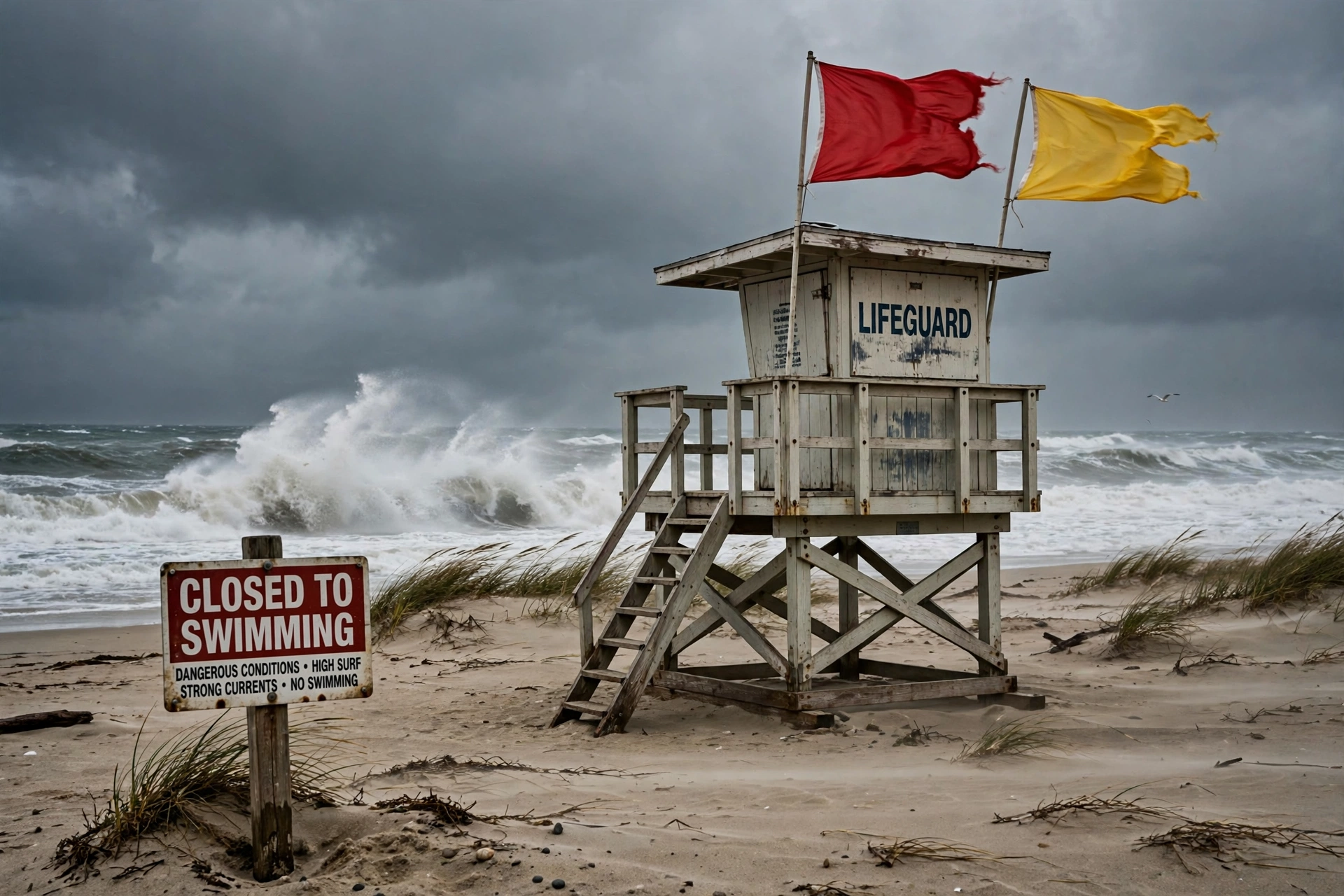
Weather statements are only one layer of beach safety. On the sand itself, the most immediate warning system is the set of colored flags flown by lifeguards and beach authorities. While flag systems vary slightly by country and locality, the general language is consistent: green typically means low hazard with calm conditions, yellow signals moderate surf or currents requiring caution, and red means high hazard — dangerous conditions where swimming is strongly discouraged or prohibited. A double red flag, where used, generally means the water is closed to the public entirely.
Alongside flags, many beaches use warning signs posted at access points during hazardous events, and lifeguards may use public-address announcements, whistles, and direct verbal warnings. These on-the-ground systems work hand in hand with NWS products like the beach hazards statement: the statement provides the regional forecast and official alert, while flags and lifeguards translate it into real-time, location-specific guidance.
NOAA also provides a daily rip current outlook using a simple three-tier risk scale that appears in Surf Zone Forecasts. The three levels are:
- Low Risk: Rip currents are unlikely, but they can still occur, especially near jetties and piers. Stay alert.
- Moderate Risk: Life-threatening rip currents are possible in the surf zone. Swimmers should use caution and swim near lifeguards.
- High Risk: Life-threatening rip currents are likely. Swimming is not recommended; only the most experienced swimmers should enter the water, and only near lifeguards.
The golden rule of beach warning systems is simple: when the flags, the signs, and the forecast all agree, believe them. If a beach hazards statement is in effect and red flags are flying, the ocean is telling you to stay out — no swim, surf session, or photo is worth the risk. For more on NOAA’s official guidance, see NOAA’s Rip Current Safety page.
Rip Currents: The Hidden Danger Behind Many Beach Hazards Statements
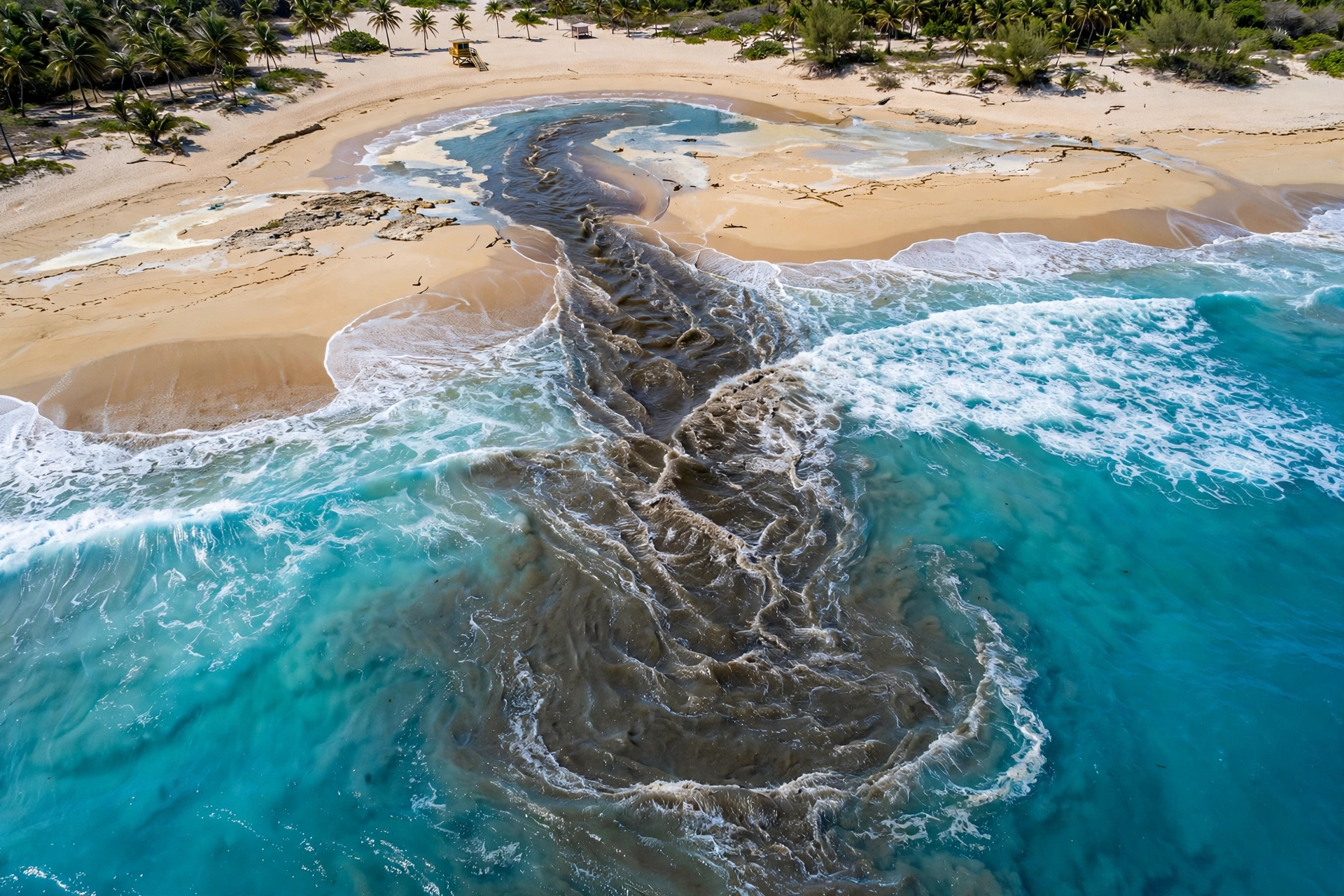
Rip currents are narrow, fast-moving channels of water flowing away from the shore, and they are one of the leading causes of beach drownings in the United States. They form when waves break strongly in some locations and weakly in others; the excess water piled up near the shore funnels back out to sea through the path of least resistance, creating a current that can move faster than an Olympic swimmer. A rip current does not pull you under the water, as movies suggest — it pulls you out, away from the beach, often faster than you can swim back.
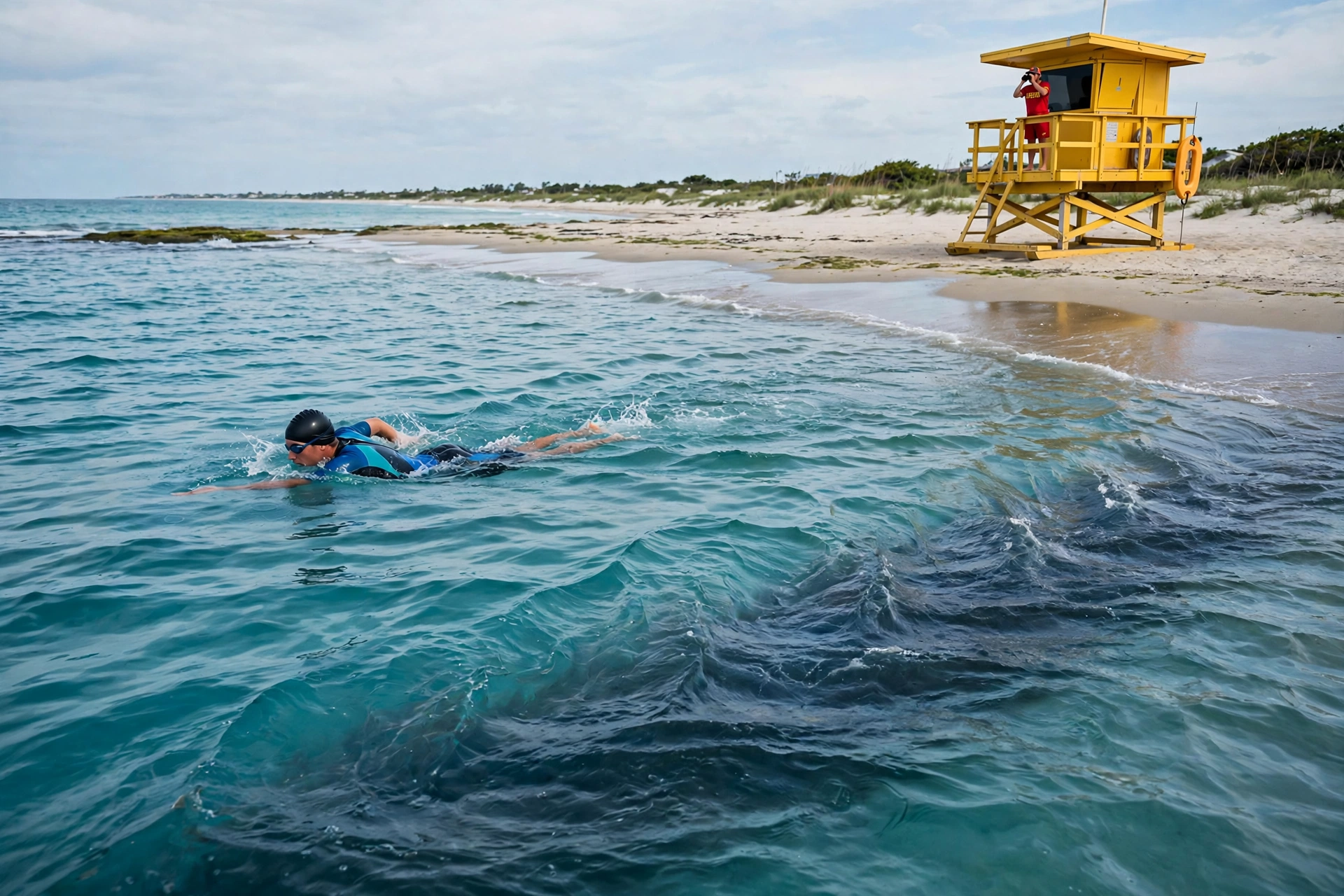
Learning to spot a rip current before you enter the water is a genuine lifesaving skill. Look for these visual clues:
- Churning, choppy water: A distinct band of agitated water cutting through calmer surf.
- A narrow channel of discolored or murky water: Water that looks browner, greener, or darker than the surrounding surf, where sand and sediment are being dragged seaward.
- A line of foam moving seaward: Foam, seaweed, or debris drifting steadily away from the beach rather than washing toward it.
- A break in the wave pattern: An area where waves are not breaking, or are breaking farther out, flanked by zones of breaking waves on either side.
Rip currents are most common near structures such as jetties, piers, and groins, where the water flow is disrupted — one more reason official guidance tells you to stay at least 100 feet (about 30 meters) away from piers and jetties. They can also appear suddenly as sandbars shift, which means a beach that was safe yesterday can develop a dangerous rip today. This variability is exactly why forecast products like the beach hazards statement and the daily rip current outlook exist: conditions change, and the alerts change with them.
When a beach hazards statement cites strong rip currents — as the current North Coast California statement does — it means forecasters expect these currents to be powerful, widespread, and life-threatening. Heed it the way you would a tornado warning: the danger is real, it is nearby, and the safest action is to stay out of the water entirely.
Sneaker Waves: Why You Should Never Turn Your Back on the Ocean
If rip currents are the hidden danger beneath the surface, sneaker waves are the ambush from above. A sneaker wave is a disproportionately large wave that arrives suddenly among much smaller waves, running far up the beach without warning. As the NWS forecaster explained, you can enjoy “20 to 30 minutes of really small waves… then a few wave sets much larger.” The long calm lulls people into a false sense of security — children play at the waterline, photographers edge closer for the perfect shot, beachcombers wander onto wet rocks — and then a single massive surge sweeps across the sand.
Sneaker waves are especially notorious along the Pacific coast, where long-period swells generated by far-off storms arrive with enormous energy. They can knock adults off their feet, drag people into frigid, turbulent water, sweep logs and debris across the beach like battering rams, and pull victims into the surf before anyone can react. Rocks and jetties are the deadliest places to encounter one, because a sneaker wave can wash completely over a rock that seemed safely above the waterline seconds earlier.
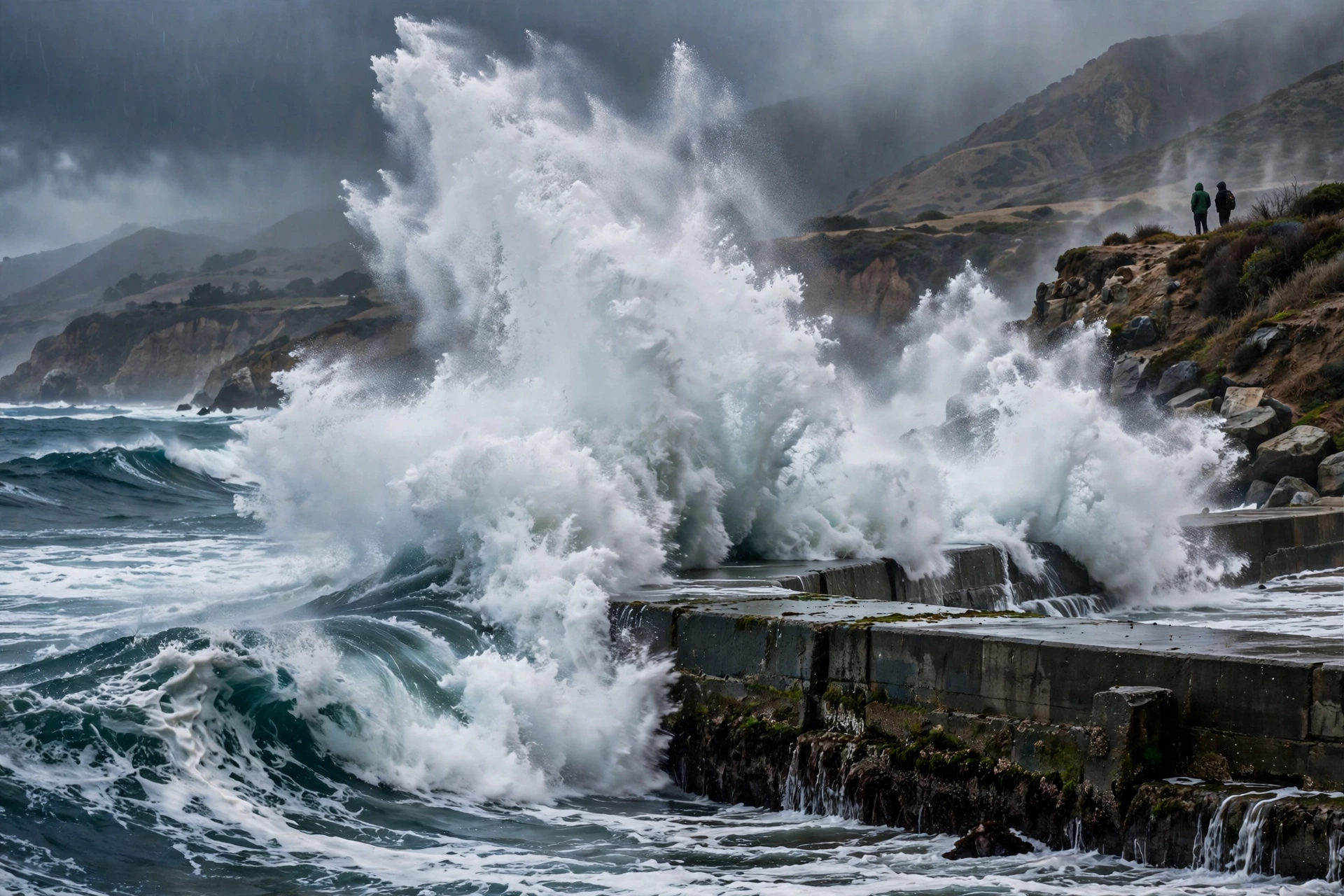
The defense against sneaker waves is behavioral, not technical, which is why the NWS guidance is so blunt: never turn your back on the ocean. Keep your eyes on the water, stay well above the high-tide line, and treat wet sand as a warning sign — it means a sneaker wave has recently reached that spot and another could follow. Stay off jetties, piers, and exposed rocks entirely during a beach hazards statement, and keep children and pets close and uphill from the waterline. If you are on the beach when a sneaker wave surge arrives, move quickly to higher ground rather than trying to outrun the water along the shore.
Rip Current Survival Guide: What to Do If You Are Caught
Even careful swimmers can be caught in a rip current. What you do in the first sixty seconds determines the outcome, so commit these steps to memory before you ever need them. The U.S. Coast Guard and the National Weather Service give consistent, lifesaving guidance:
- Do not panic. Panic burns energy and leads to poor decisions. A rip current will not pull you underwater — it pulls you outward. You have time to think and act.
- Do not swim against the current. This is the fatal mistake. Trying to swim straight back to shore against a rip current leads to exhaustion, and exhaustion leads to drowning. Even strong swimmers cannot outswim a powerful rip.
- Swim parallel to the shore to escape the current. Rip currents are typically narrow — often no wider than 30 to 100 feet. Swimming parallel to the beach will carry you out of the channel and into calmer water.
- Once free of the current, swim at an angle back to the beach. After escaping sideways, swim diagonally toward shore, away from the rip, until you can stand or reach safety.
- If you cannot escape, float or tread water. Conserve your energy. The current weakens farther from shore, and you may be able to swim back once it dissipates.
- Wave and call for help. If you need assistance, face the shore, call out, and wave your arms to attract the attention of lifeguards or other beachgoers.
Bystanders have a critical role, too — and the most important rule is: do not swim out to rescue someone yourself unless you are a trained lifeguard. Well-meaning rescue attempts frequently create two victims instead of one. Instead, call 911 immediately, alert a lifeguard, throw the person something that floats (a cooler, a boogie board, a life ring), and keep your eyes on them so you can direct rescuers. NOAA’s detailed safety materials at NOAA JetStream: Rip Current Safety reinforce these steps and are worth reviewing with your family before any beach trip.
Teaching children a simplified version — “stay calm, float, wave your arms, and yell for help” — can save a young life. And remember that flotation devices, while helpful, are not a substitute for knowing the escape technique; currents can separate swimmers from inflatables in seconds. If you want more safety reading in the same spirit, check out another Events Day safety guide on staying safe in warm freshwater.
Before You Go: The Beach Safety Checklist
The best beach emergency is the one that never happens. NOAA’s official advice starts with two short phrases worth memorizing: know how to swim, and KNOW BEFORE YOU GO — check the Surf Zone Forecast. A few minutes of preparation at home can prevent a crisis at the shoreline. Run through this checklist before every beach trip:
- Check the forecast: Look at the NWS Surf Zone Forecast for your beach, including the rip current outlook (Low, Moderate, or High Risk) and whether any beach hazards statement, high surf advisory, or coastal flood alert is in effect.
- Swim at lifeguard-protected beaches: The presence of trained lifeguards dramatically improves survival odds in any emergency. Choose guarded beaches whenever possible.
- Obey all lifeguards, signs, and flags: Posted warnings reflect real-time conditions. If swimming is discouraged or prohibited, respect the call.
- Never swim alone: Always use the buddy system so someone can call for help if you get into trouble.
- Stay at least 100 feet (30 meters) from piers and jetties: Structures concentrate currents and create the most dangerous rip conditions. Give them a wide berth, in and out of the water.
- Know the escape technique: Make sure everyone in your group knows not to fight a rip current — swim parallel to shore, then angle back to the beach.
- Watch the water continuously: Designate a “water watcher” when children are near the surf, and never turn your back on the ocean — especially during sneaker wave events.
- Bring safety gear: Pack a basic first-aid kit, a charged phone in a waterproof pouch, and flotation aids for weak swimmers.
- Learn the local emergency number and beach access points: Know how to direct rescuers to your exact location — beach name, nearest lifeguard tower, or access stairway.
What to Do During a Beach Hazards Statement
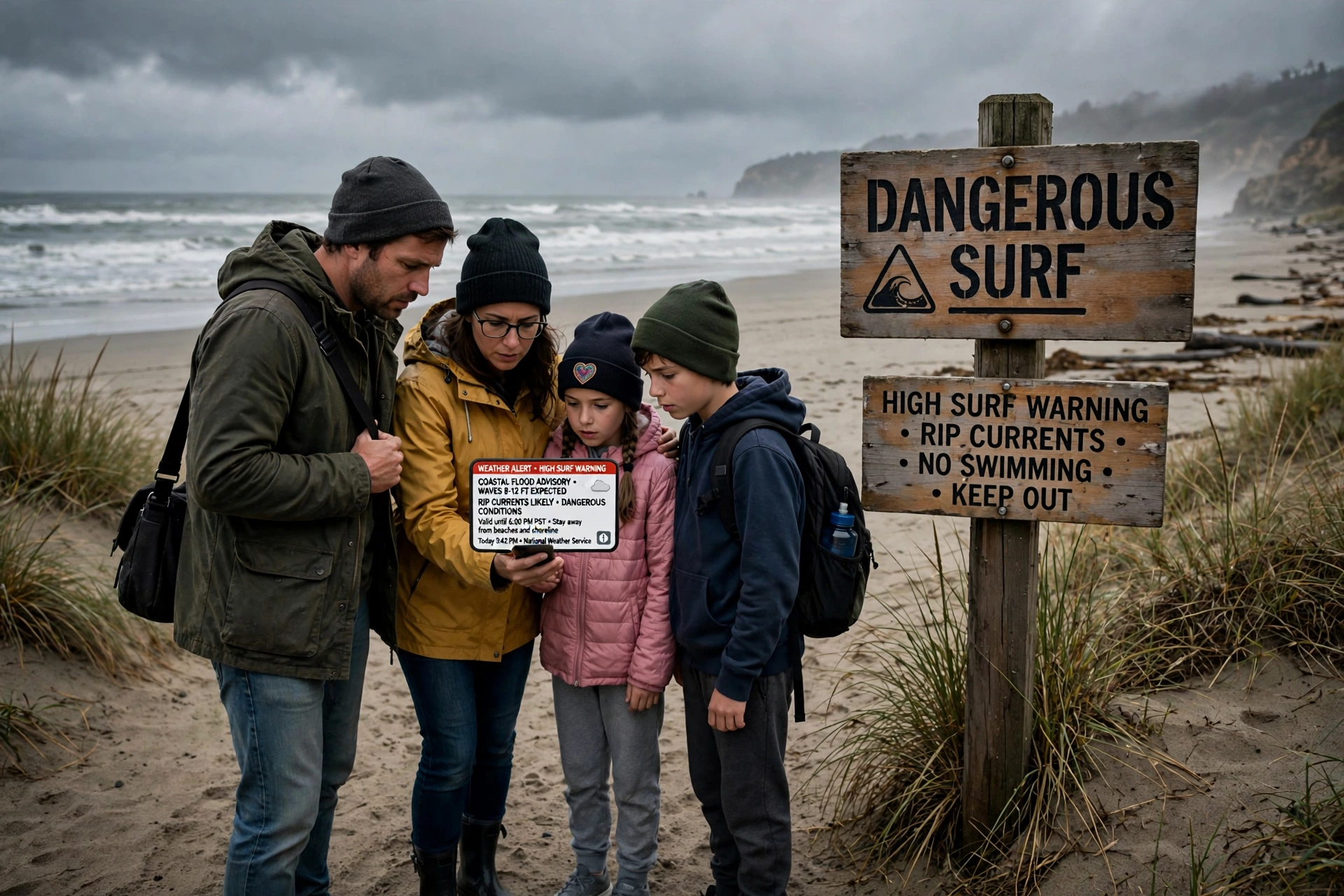
When a beach hazards statement is in effect for your coastline, adjust your plans rather than testing the ocean’s mood. The U.S. Coast Guard’s guidance is clear: stay clear of beaches until lifeguards or law enforcement announce that it is safe to return. That does not necessarily mean canceling your beach day — it means changing how you enjoy it.
Safe alternatives during a statement include walking well above the high-tide line while facing the ocean, exploring tide pools only at low tide and on stable ground away from surge zones, visiting beachside shops and restaurants, or choosing an inland activity until the alert expires. If you do go to the sand, keep children and pets far from the water’s edge, stay off all rocks, jetties, and piers, and keep watching the surf for the entire visit — remember the forecaster’s warning about 20 to 30 minutes of small waves followed by much larger sets.
For surfers and experienced ocean users, a statement is not a personal challenge. Even strong swimmers drown in rip currents every year, and sneaker waves do not discriminate by skill level. Check with local lifeguards about whether any section of beach is considered manageable, and if the answer is no, respect it. The ocean will still be there when the statement expires.
More from Events Day
Beach Hazards Statement: Frequently Asked Questions
What is a beach hazards statement?
A beach hazards statement is an alert issued by the U.S. National Weather Service warning of dangerous beach or ocean conditions — such as strong rip currents, sneaker waves, large breaking waves, high surf, or minor coastal flooding. It names the affected coastline, the time period, the expected impacts, and precautionary actions like staying out of the water and off jetties, piers, and rocks.
Why is a beach hazards statement issued?
The National Weather Service issues a beach hazards statement when forecasters expect conditions that threaten swimmers and beachgoers, most commonly strong rip currents, sneaker waves, large breaking waves, or high surf. The goal is to give the public, lifeguards, and local officials advance warning so people can stay out of danger before conditions turn deadly.
What should I do during a beach hazards statement?
During a beach hazards statement, stay out of the water, stay off jetties, piers, and rocks, and never turn your back on the ocean. The U.S. Coast Guard advises staying clear of beaches until lifeguards or law enforcement say it is safe. You can still enjoy the coast by walking well above the high-tide line while facing the surf, but keep children and pets far from the water’s edge.
What is a sneaker wave?
A sneaker wave is a large, unexpected wave that arrives without warning among much smaller waves, surging far up the beach. An NWS forecaster described it this way: “you can have 20 to 30 minutes of really small waves… then a few wave sets much larger.” Wet sand high on the beach is a sign a sneaker wave recently struck. Never turn your back on the ocean during sneaker wave events.
How do I escape a rip current?
To escape a rip current: do not panic and do not swim against the current. Swim parallel to the shore until you are out of the narrow current channel, then swim at an angle back to the beach. If you cannot escape, float or tread water to conserve energy — the current weakens farther from shore — and wave and call for help. Bystanders should call 911 and throw something that floats rather than swimming out themselves.
How can I tell if a rip current is present before swimming?
Look for churning, choppy water cutting through calmer surf; a narrow channel of discolored or murky water; a line of foam, seaweed, or debris moving steadily seaward; or a gap in the breaking waves. Also check NOAA’s daily Surf Zone Forecast for the rip current risk level — Low, Moderate, or High — and always swim at lifeguard-protected beaches, never alone, and at least 100 feet from piers and jetties.
Conclusion: Respect the Statement, Respect the Ocean
A beach hazards statement is one of the most practical alerts the National Weather Service produces — a short, clear message that the ocean along a particular coastline has become dangerous. The current statement for the California North Coast, in effect through Wednesday afternoon with its warnings of sneaker waves, strong rip currents, and large breaking waves, is a textbook example of why these alerts exist and why search interest in the term has surged past 20,000 queries.
The safety principles are simple enough to teach a child and important enough to save an adult: know before you go by checking the Surf Zone Forecast; swim only at lifeguard-protected beaches and never alone; stay 100 feet from piers and jetties; never turn your back on the ocean; and if a rip current catches you, do not fight it — swim parallel to the shore, then angle back to the beach, or float and wave for help. Share this guide before your next coastal trip, and the next time a beach hazards statement appears in your forecast, you will know exactly what it means — and exactly what to do. For further reading, see the local coverage of this week’s coastal hazard event at this week’s coastal coverage.