

Key Facts: 31 New Deep Sea Species Discovered (September 2026)
What: 31 previously undescribed species found in the tropical midwaters of the South Atlantic off Brazil’s coast.
Who: An international team led by chief scientist Karen Osborn (Smithsonian National Museum of Natural History) aboard the Schmidt Ocean Institute’s research vessel Falkor (too).
How: Three non-invasive imaging systems on the ROV SuBastian — DeepPIV, EyeRIS (both developed by MBARI), and a shadowgraph camera from Japan’s JAMSTEC — plus genome sequencing and the Stanford-developed “Squid microscope.”
Why it matters: New imaging technology confirmed dozens of new species in days rather than years, and proved the midwater — Earth’s largest habitat — remains largely unknown.
Focus keyword: new deep sea species
An oceanic expedition off the coast of Brazil has just turned up 31 new deep sea species from one of Earth’s most mysterious habitats: the dimly lit midwater zone between the sunlit surface and the deep ocean floor. The discovery, announced in September 2026, is part of a remarkable wave of deep sea breakthroughs this month — from roughly 40 newly found species in Argentina’s Mar Del Plata Submarine Canyon to a once-in-a-decade sighting of a bigfin squid off California.
In this guide, we break down exactly what scientists found off Brazil, the futuristic technology that made it possible, and why the deep ocean keeps revealing life we never knew existed.
The Brazil Expedition: 31 New Deep Sea Species in the Midwater Zone
The international team of scientists sailed aboard the Schmidt Ocean Institute’s research vessel Falkor (too), working in the tropical midwaters of the South Atlantic Ocean off the coast of Brazil. Chief scientist Karen Osborn, a research zoologist at the Smithsonian National Museum of Natural History, led the cruise.
“The largest habitat on Earth, the midwater, is filled with incredible animals we are only just starting to understand,” Osborn said.
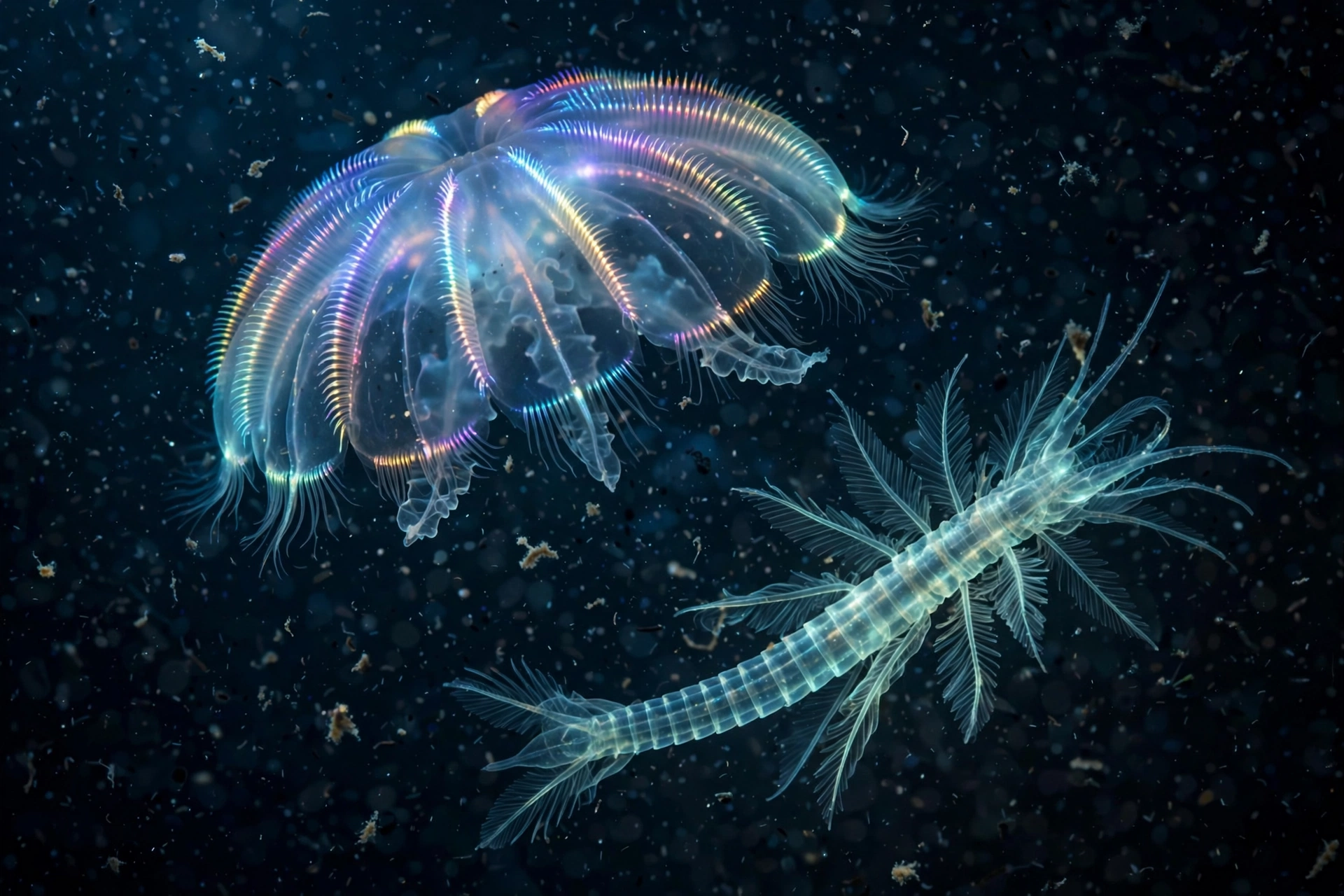
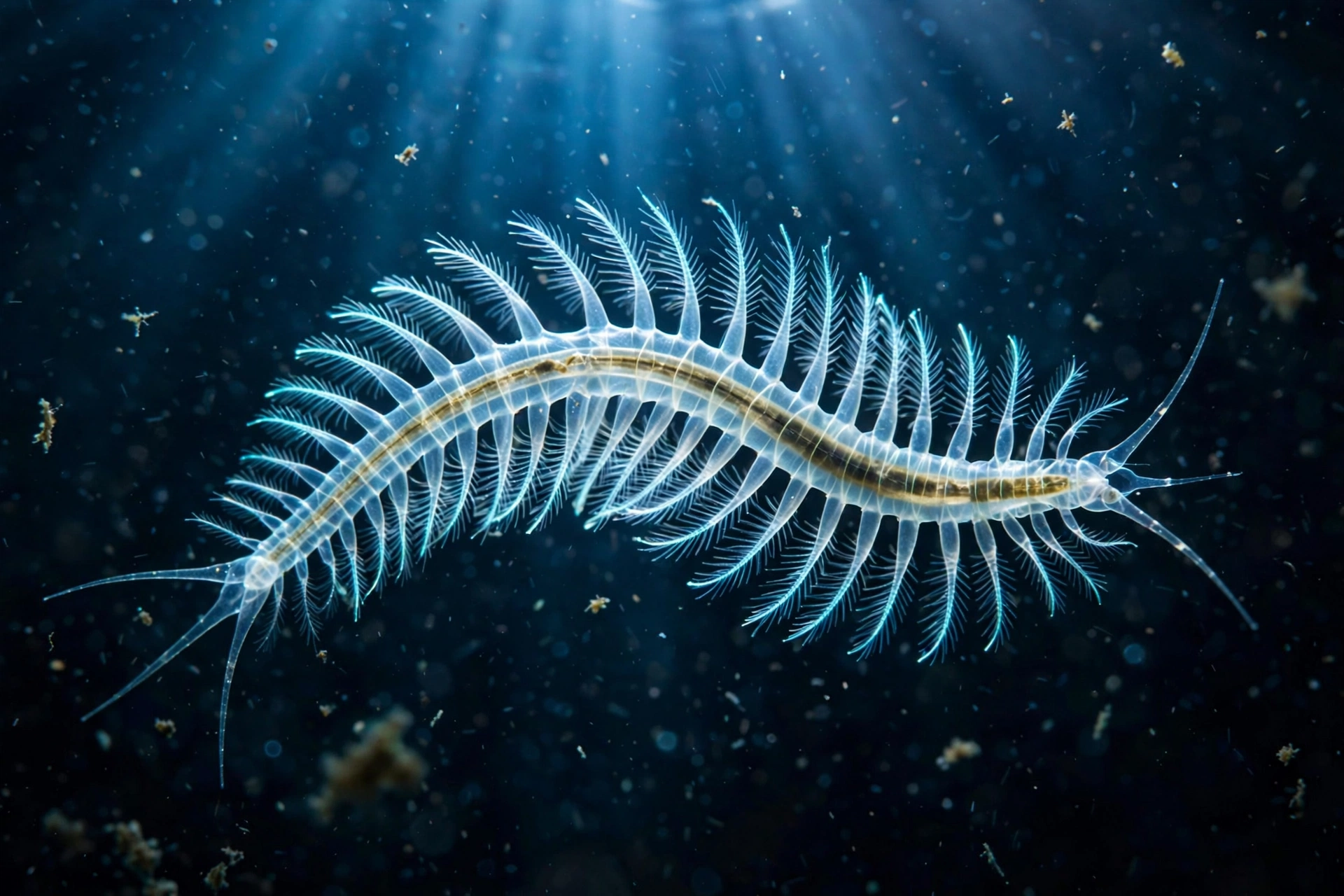
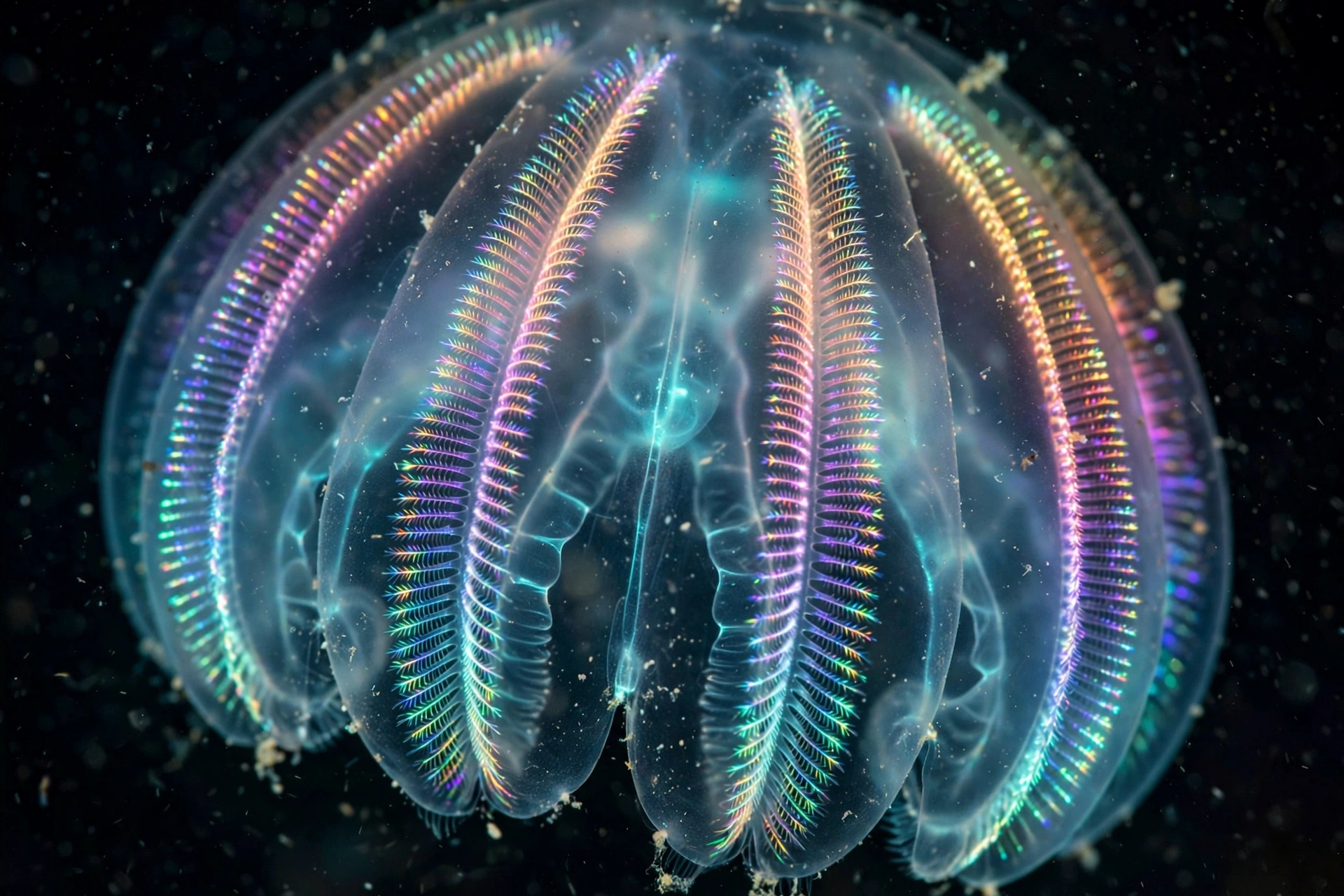
The midwater zone — the vast column of water between the sunlit surface and the deep seafloor — is the largest living space on the planet, and most of it remains unexplored. The newly discovered animals have what scientists describe as an extraterrestrial appeal: hypnotically beautiful, ghostly gossamer worms (Tomopteris), comb jellies propelled by glittering finger-like appendages, and giant rhizarians — single-celled organisms mind-bogglingly massive enough to be visible to the naked eye.
Other finds read like creatures from another world:
- Larvaceans — tadpole-like animals that build balloon-like “houses” out of mucus to trap tiny food particles drifting by.
- Siphonophores — astoundingly alien-like colonies of specialized clones, or zooids, that work together as a single colonial creature.
- A juvenile glass squid, collected by the ROV SuBastian at 779 meters (about 2,555 feet) depth in the South Atlantic.
First-of-its-Kind Technology: Imaging Life Without Touching It
What makes this expedition truly historic is not just what was found — it is how it was found. Deep-water animals are soft and gelatinous to withstand extreme pressure, so conventional sampling nets deform and destroy them. As one commentator noted, the unjustly “uglified” blobfish is a perfect example of what happens when delicate deep sea creatures are dragged to the surface.
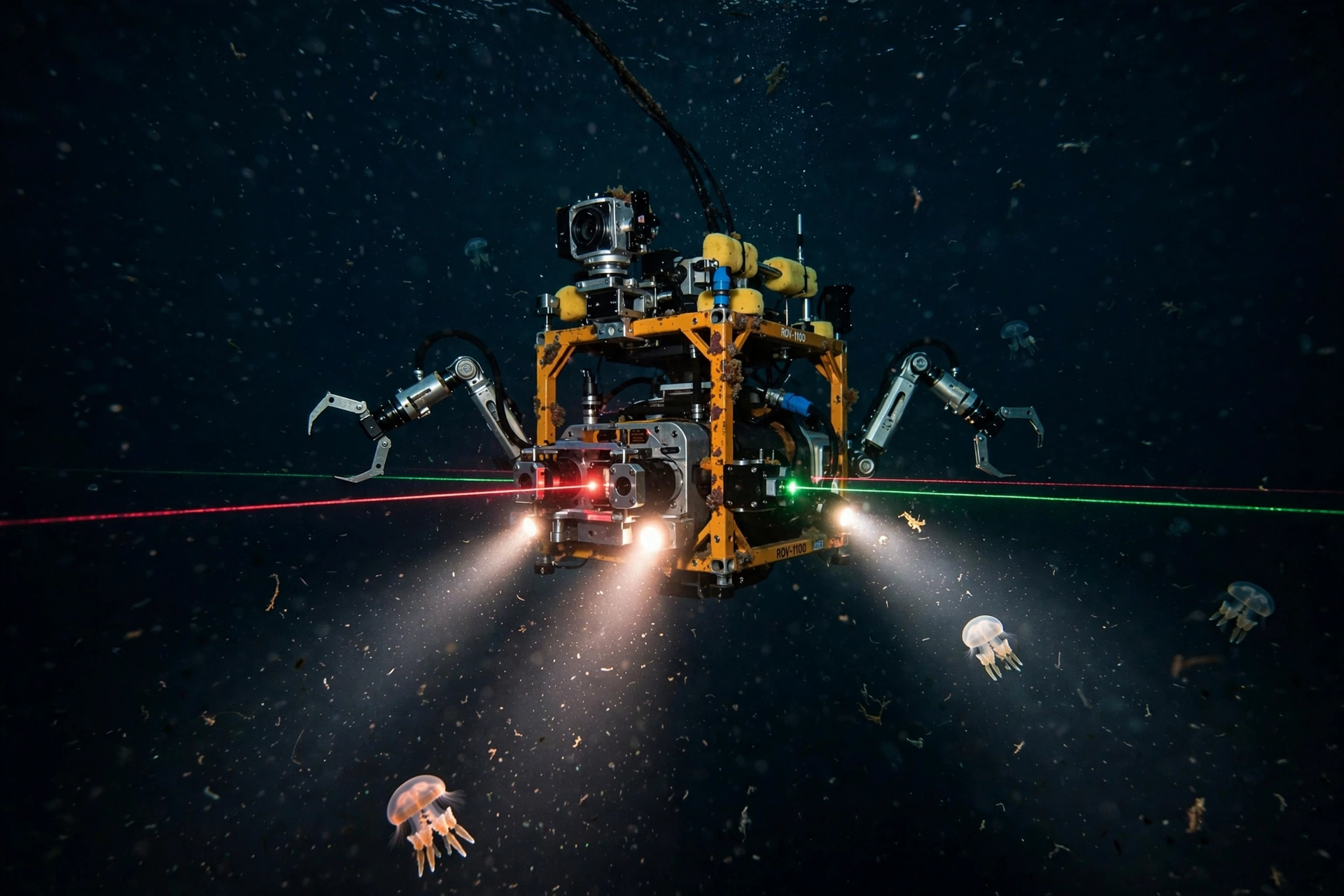
The Brazil team used three sophisticated imaging systems attached to the remotely operated vehicle (ROV) SuBastian, studying midwater critters in their natural environment without harming them:
- DeepPIV — a particle image velocimetry instrument that creates 3D images of creatures by non-invasively scanning them with lasers.
- EyeRIS (remote imaging system) — paired with DeepPIV to build detailed three-dimensional scans.
- Shadowgraph camera — developed by the Japan Agency for Marine-Earth Science and Technology (JAMSTEC) to capture high-contrast silhouettes, revealing finer creature features not visible via laser scanning.
Both DeepPIV and EyeRIS were developed by the Monterey Bay Aquarium Research Institute (MBARI).
The Squid Microscope: Seeing Living Cells in 3D at Sea
In a first-of-its-kind achievement, the researchers used the “Squid microscope” developed at Stanford University to view the living cellular structure of a single-celled microbe called a protist — its living cells and glass skeleton rendered in three dimensions, right there at sea.
The same ultra-precise 3D live imaging revealed fine details like individual cone cells in the disproportionately large eyes of small, shrimp-like crustaceans called amphipods.
The team also explored animal behavior through a virtual reality application developed at the University of Western Australia and a hydrodynamic “treadmill” designed at Stanford — an upright circular chamber mimicking an endless water column to observe the tiny, briny behaviors of microbes without experimental interference.
“It’s an incredible honor to not only view and experience this rare and inspiring midwater life, but also to be able to work towards describing and sharing that life broadly through the use of novel, non-invasive technologies,” said Kakani Katija, a bioengineer at MBARI.
New Deep Sea Species in Days, Not Decades
This expedition is notable for demonstrating the efficacy of these new technologies: scientists could confirm numerous previously undescribed species in just days rather than years or decades.
“Schmidt Ocean Institute’s mission is to push technological advancement, and this was our third cruise in collaboration with this team of scientists and engineers to test and further develop this innovative midwater equipment,” said physical oceanographer Jyotika Virmani, the institute’s Executive Director. “We look forward to a future in which scientists study marine life as elegantly as this team did — and in virtual reality.”
As with other recent newly discovered animals — including the Tilcayo tiger cat species found in Bolivia — formal description and naming of these deep sea species will follow through peer-reviewed research, but the imaging and genome sequencing data are already confirming their novelty.
September 2026: A Month of Deep Sea Breakthroughs
The Brazil discovery is the headline of a remarkable September for deep sea science. Here is what else has surfaced in the last two weeks:
~40 New Species — and Plastic — at 4,000 Metres Off Argentina
Nearly 4,000 metres below the surface in the Mar Del Plata Submarine Canyon off Argentina’s south coast, an international team documented roughly 40 species new to science during the summer of 2025 — the first time scientists had ever imaged the seafloor there.
But the celebration came with a troubling footnote: across 10 of 17 remotely operated submersible dives, researchers saw 29 identifiably manmade objects — plastic bags, fishing gear, food wrappers, and even an old boot. Starfish and corals were found attached to the debris, partially subsuming plastic packaging and fishing ropes. The findings were published in PLOS One (Teso et al., 2026).
For context, CSIRO and the University of Toronto estimate up to 11 million tonnes of plastic pollution sits on the ocean floor, with roughly 54% of it at depths of 200 to 11,000 metres.
Elusive Bigfin Squid Spotted Alive Off California
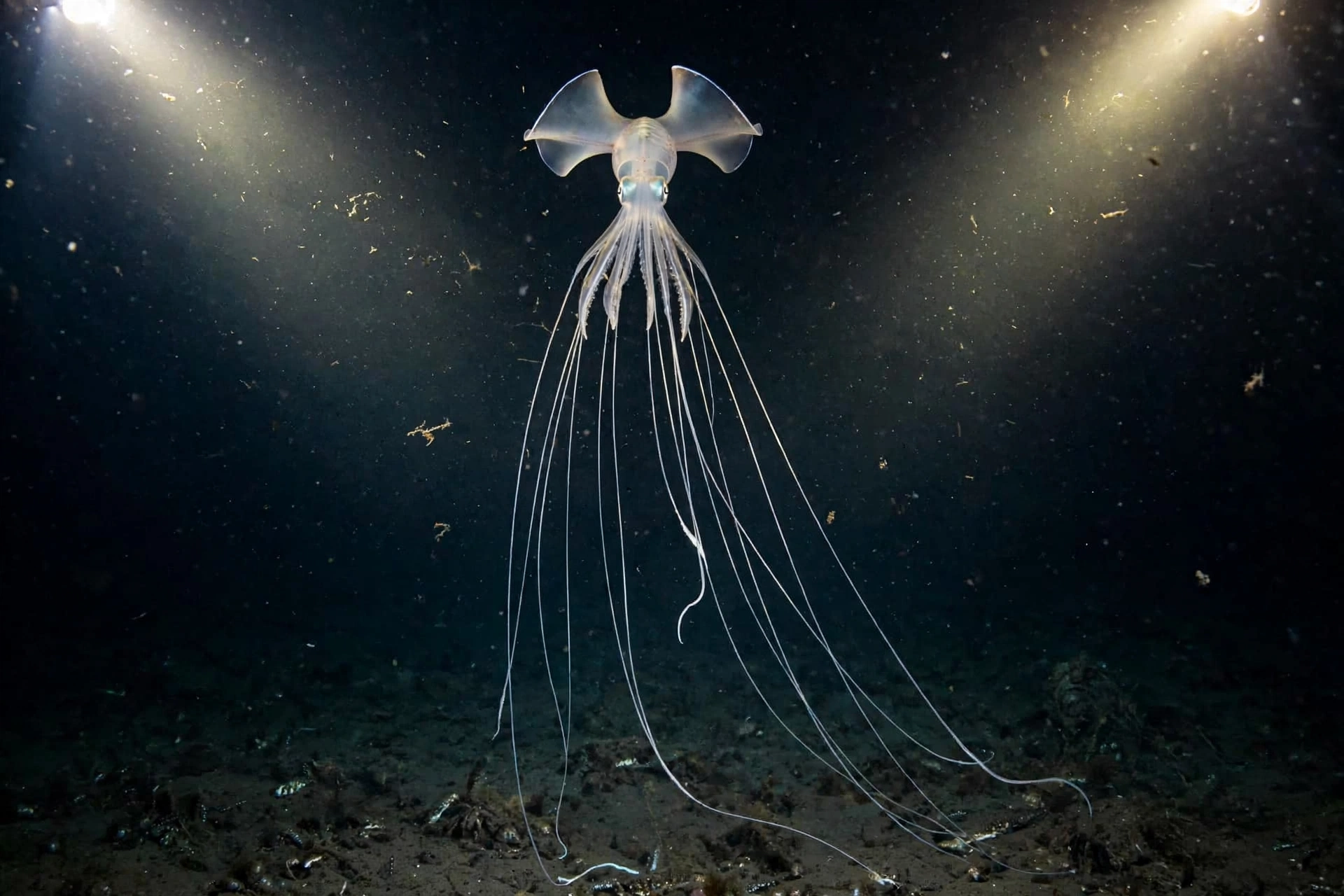
On August 7, 2026, MBARI ecologist Olívia Soares Pereira spotted a rare bigfin squid (Magnapinna genus) nearly two miles below the surface, about 80 miles southwest of Monterey, California — the first time the ethereal creature has ever been seen alive in the northeastern Pacific. Announced September 2, the sighting joins only about 70 total observations or collections of the species.
Deep Sea Crustaceans Caught Hitchhiking on Giant Sea Spiders
Thousands of metres down in the Chilean Margin of the southeastern Pacific, cameras on the ROV SuBastian caught shrimp-like amphipods (Mesopleustes abyssorum) clinging to giant sea spiders (Colossendeis colossea) scuttling on the ocean floor. The team, led by Jorge Pérez-Schultheiss of Chile’s National Museum of Natural History, observed the hitchhiking at two sites about 140 miles apart — suggesting the behavior may be commonplace. Published in Ecology, 2026.
Pregnant Antarctic Krill Thriving at Hydrothermal Vents
At the Hook Ridge and Quest Caldera vent fields, researchers found mature, egg-carrying female Antarctic krill — all recently mated — swimming among the vents. Video showed additional gravid females near vent structures, with no males observed during nearly nine hours of footage. Published in Communications Biology, 2026, the finding suggests vents may offer nutritional or reproductive advantages that outweigh the cost of deep vertical migration.
Why Do We Keep Finding New Deep Sea Species?
Scientists estimate we know more about the surface of the Moon and Mars than we do about the deep Atlantic. The deep ocean’s extreme pressure, darkness, and inaccessibility have kept most of its life hidden — and fragile deep sea species are easily destroyed by traditional sampling, meaning countless creatures passed through nets unrecognized.
Three factors explain the current wave of discoveries:
- Better robots: ROVs like SuBastian and Doc Ricketts bring cameras to depths no diver can reach.
- Non-invasive imaging: laser scanning and 3D microscopy identify species without collecting or damaging them.
- Genome sequencing: DNA barcoding confirms which animals are truly new to science — in days, not decades.
Threats to New Deep Sea Species: Plastic, Mining, and Warming
Each new discovery is a race against human impact. Beyond the plastic litter documented in the Mar Del Plata canyon, the deep sea faces:
- Deep-sea mining — proposals to harvest minerals from the ocean floor threaten habitats that took millions of years to form.
- Bottom trawling — fishing gear that scrapes the seafloor, destroying cold-water coral ecosystems.
- Climate change — warming and acidification are altering even the deep ocean’s chemistry and oxygen levels.
As one researcher put it during the recent deep-sea microbe genome atlas study published in Cell (2026): “It is critical to understand what’s down there before we change it.”
How to Follow Deep Sea Discoveries
The Schmidt Ocean Institute streams ROV dives live during expeditions, and institutions like MBARI publish footage of rare encounters — such as the bigfin squid — on their websites. Following these research institutes is the best way to watch the next new deep sea species discovery happen in real time.

More from Events Day
Frequently Asked Questions About New Deep Sea Species
How many new deep sea species were discovered off Brazil in 2026?
31 new species were confirmed from the tropical midwaters of the South Atlantic off Brazil during a September 2026 expedition aboard the Schmidt Ocean Institute’s Falkor (too), led by Smithsonian zoologist Karen Osborn. Advanced imaging and genome sequencing confirmed their novelty.
What is the midwater zone?
The midwater zone is the vast column of water between the sunlit ocean surface and the deep seafloor. It is the largest habitat on Earth, yet much of it remains unexplored because its delicate animals are extremely difficult to study without damaging them.
How do scientists discover new deep sea species without collecting them?
The Brazil expedition used three non-invasive imaging systems on the ROV SuBastian: DeepPIV and EyeRIS laser-scanning instruments (developed by MBARI) for 3D imaging, a shadowgraph camera from Japan’s JAMSTEC for high-contrast silhouettes, and Stanford’s “Squid microscope” for live 3D imaging of cellular structures — all combined with genome sequencing.
What were the 31 new species found off Brazil?
Highlights include ghostly bioluminescent gossamer worms (Tomopteris), comb jellies, giant single-celled rhizarians visible to the naked eye, mucus-house-building larvaceans, colonial siphonophores, and a juvenile glass squid collected at 779 metres depth.
What other new deep sea species were discovered in September 2026?
Separately, researchers documented roughly 40 new species in Argentina’s Mar Del Plata Submarine Canyon at nearly 4,000 metres depth, spotted a rare bigfin squid alive for the first time in the northeastern Pacific off California, and observed shrimp-like amphipods hitchhiking on giant sea spiders off Chile.
Why are new deep sea species important?
They reveal how life adapts to extreme pressure, darkness, and cold; expand our understanding of Earth’s largest habitat; and offer potential biotechnology and pharmaceutical insights — deep-sea microbes have shown genetic potential for novel compounds. Discoveries also strengthen the case for protecting deep ocean ecosystems from mining and pollution.
How much of the deep sea is still unexplored?
The vast majority. Scientists say we know more about the surface of the Moon and Mars than we do about the deep Atlantic, and the ATLAS project — which explored 12 locations in the deep northern Atlantic over nearly five years — showed how much remains to be found: a dozen new species, 35 species in previously unknown areas, and 113 peer-reviewed papers.
Conclusion: The Deep Sea Keeps Surprising Us
The 31 new deep sea species discovered off Brazil are more than a scientific curiosity — they are proof that Earth’s largest habitat still holds worlds we have barely glimpsed. Thanks to non-invasive imaging technology, scientists can now document these fragile creatures in days instead of decades, racing to understand the deep ocean before human activity changes it forever.
From ghostly gossamer worms to giant single-celled rhizarians, each discovery reminds us: the deep sea is not empty — it is simply waiting to be seen.
Sources: ScienceAlert; Oceanographic Magazine; Phys.org (PLOS One, Teso et al., 2026); Smithsonian Magazine.